The Speaking Industry Isn’t Dying. It’s Being Reborn
Let me be straight with you. If you’ve been wondering whether professional speaking still has a future, you’re asking the wrong question.
The speaking industry has fundamentally transformed since 2020. Live events vanished overnight. Stages went silent. Calendars emptied. For many speakers, it felt like watching their entire career collapse in real-time.
I remember the panic. The uncertainty. Watching my speaking calendar (once booked solid six months out) become completely empty within two weeks. The phone stopped ringing. Event planners were apologizing, canceling, postponing indefinitely.
But here’s what actually happened: the industry didn’t die. It evolved.
And if you’re willing to evolve with it, speaking has never been more relevant, more needed, or more profitable than it is right now in 2026.
Why AI Actually Makes Human Speakers More Valuable
We’re living in the age of synthetic everything. AI can generate videos, clone voices, create realistic faces, and produce entire presentations in seconds. By 2026, deepfakes are so convincing that major news organizations now require multiple verification sources before trusting any video content.
Think about that for a moment. We’ve reached a point where seeing is no longer believing.
Here’s the shift nobody saw coming: audiences are craving authenticity more than information.
They can get facts from ChatGPT. They can watch AI-generated content on YouTube. They can read perfectly written articles that were never touched by human hands. Information is infinite and instant.
What they can’t get is the energy of a real human being standing in front of them, sharing personal experience, responding in real-time to the room. They can’t get the pause before an emotional story. They can’t get the authenticity of someone who’s lived through what they’re teaching.
Your presence (your imperfections, your humanity, your lived experience) is now your competitive advantage. When everything else feels manufactured, genuine human connection stands out like never before.
I’ve seen this firsthand. In 2025, I spoke at a corporate event where the opening keynote was an AI-generated presentation. Technically perfect. Visually stunning. Completely forgettable.
When I took the stage and shared a personal failure (a speaking gig that went terribly wrong), the room came alive. People leaned in. They engaged. They connected. Not because my content was more advanced, but because it was real.
Virtual Speaking Isn’t the Consolation Prize Anymore
When live events disappeared from my calendar in 2020, I had a choice: panic or adapt. I chose adaptation.
Virtual delivery became my new normal. Did I charge my full keynote fee for a Zoom presentation? Not at first. But here’s what I gained that I never expected:
- No flights, hotels, or recovery days eating into my profit margin
- Ability to reach global audiences without destroying my health
- Sharper, more consistent delivery without physical exhaustion
- Multiple revenue streams through hybrid models
- The capacity to speak to three different organizations in three different countries (all in the same day)
Let me paint you a picture of what my speaking life looked like before. Four back-to-back engagements. Monday in Los Angeles. Tuesday in New York. Thursday in Chicago. Friday in Miami. By the time I got home, I was completely drained. Jet-lagged. Disoriented. Running on fumes and coffee.
Virtual delivery gave me something I didn’t even know I needed: sustainability.
By 2026, the best speakers aren’t choosing between virtual and live. They’re mastering both. Hybrid events are the standard now, not the exception. Organizations expect you to deliver powerfully on camera and on stage.
The speakers who are thriving right now have invested in professional lighting, broadcast-quality microphones, and camera presence training. They understand framing. They know how to engage through a screen. They’ve practiced looking at the camera lens instead of their own face.
If you haven’t invested in these skills, you’re leaving money on the table. Because while some speakers are still waiting for things to “go back to normal,” smart speakers have built entire businesses around virtual and hybrid delivery models.
The Knowledge Economy Explosion Nobody Talks About
While live speaking slowed down, I started packaging my expertise into courses and coaching programs. That decision turned into my most profitable move.
The knowledge business has exploded. By 2026, it’s a multi-trillion dollar industry, and it’s still growing. People aren’t just attending conferences anymore. They’re investing in ongoing learning relationships.
They’re buying:
- Masterclasses and online courses that teach specific, actionable skills
- Executive coaching and mastermind groups for accountability and community
- Micro-learning and bite-sized content they can consume on their schedule
- Community-based learning experiences that extend far beyond a single event
- Certification programs that give them credentials in their field
Your speaking expertise naturally extends into these formats. If you can engage an audience from stage, you can teach them in other ways too. The speakers who are thriving in 2026 have multiple ways to serve their audience (and multiple revenue streams because of it).
I know speakers who now make more money from their online courses than they ever did from keynote speaking. They’re reaching more people, creating more impact, and building recurring revenue that doesn’t require them to be on a plane every week.
That’s not a downgrade. That’s evolution.
What Audiences Actually Want (It’s Not What You Think)
Here’s the hard truth: nobody needs more information.
They need understanding. They need clarity. They need someone who sees their struggle and gives them a simple framework to move forward.
The speakers who are struggling in 2026 are still treating speaking like a TED talk. Polished performances with no room for real connection. They’re memorizing scripts. Rehearsing gestures. Trying to sound impressive.
The speakers who are thriving are having conversations, not monologues.
Audiences don’t want to be impressed anymore. They want to feel seen, understood, and equipped. They want practical takeaways they can implement Monday morning. They want frameworks that simplify complex problems. They want permission to struggle and strategies to overcome.
I learned this the hard way. Early in my career, I tried to dazzle audiences with research, statistics, and complex theories. I wanted them to think I was brilliant.
Then one day, I just told the truth. I shared my biggest failure. I admitted what I still struggle with. I gave them permission to not have it all figured out.
That talk got more standing ovations and booked more future engagements than any “impressive” presentation I’d ever delivered.
Authenticity wins. Every single time.
The Real Truth About What Organizations Are Buying
Let me tell you something most speakers won’t admit: companies aren’t hiring the world’s top expert. They’re hiring someone credible, professional, and relatable who can help their team.
Take the hot topics of 2026. AI integration in the workplace. Mental health and burnout. Generational dynamics with five generations now in the workforce. Hybrid leadership challenges. Psychological safety. Authentic communication in a digital world.
Nobody “owns” these topics. What makes your message powerful isn’t originality. It’s your personal perspective and authentic experience.
Your story of navigating AI disruption in your career? That’s what resonates. Your struggle with work-life balance while building a business? That’s what connects. Your mistakes in leadership and what you learned from them? That’s what teaches.
That’s your differentiator. Not credentials. Not fame. Not being the first person to ever talk about a topic. Your story and your perspective are what make you irreplaceable.
Because here’s what companies really want: someone who can walk into their room, understand their specific challenges, and give them practical tools to move forward. They want engagement, not entertainment. They want application, not inspiration alone.
Adaptability Is No Longer Optional. It’s Required
Many speakers are struggling today not because the industry disappeared, but because they refused to evolve.
They never learned how to look professional on camera. They ignored social media and content creation. They treated virtual delivery as temporary instead of permanent. They kept waiting for things to “go back to normal.”
Normal is never coming back. And that’s actually good news.
Because the speakers who adapted early are now positioned as leaders. They have skills their competitors don’t. They have revenue streams others ignored. They have audiences they’ve been serving consistently for years.
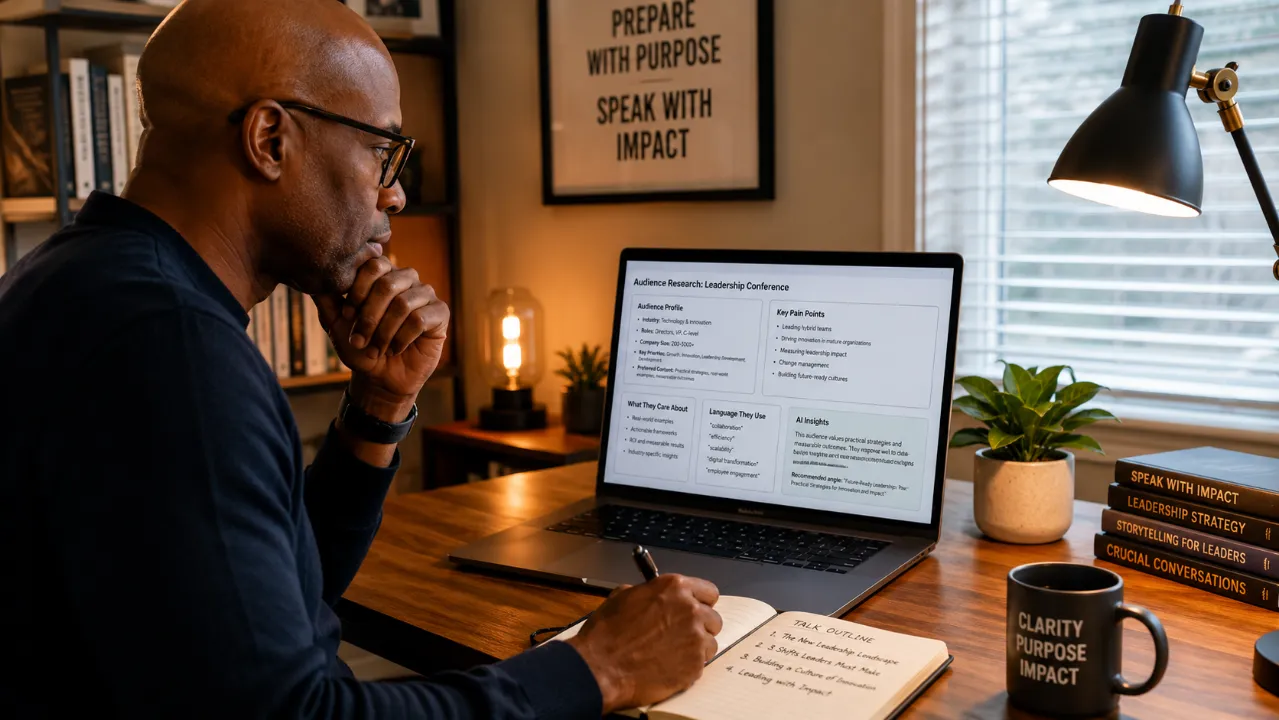
I’ll give you a personal example. Because I had already mastered virtual presentations before most speakers even tried them, coaching opportunities came to me. Organizations started asking me to train their leaders on camera presence and virtual delivery.
I started teaching other speakers and executives how to livestream effectively, how to set up a professional home studio, how to engage remote audiences. That became a six-figure income stream I never planned for.
Another example: I started creating short-form video content for social media. Five years ago, I would have rolled my eyes at that. Today? That content brings me more speaking inquiries than any marketing I’ve ever done.
Opportunity doesn’t look the way you expect it to. But it always shows up for people who are prepared.
Your Mindset Determines Everything
The most important shift isn’t external. It’s internal.
You can tell yourself this moment is happening to you, or you can decide it’s happening for you. That choice shapes everything. Your focus. Your actions. Your outcomes.
I’ve watched speakers with incredible talent give up because they decided the industry betrayed them. And I’ve watched speakers with less experience build thriving careers because they decided to see opportunity in change.
The difference wasn’t talent. It was mindset.
When you decide to be a creator instead of a victim, your thinking changes. You see ways to serve. You start building instead of waiting. You focus on impact instead of protection. You ask “What can I create?” instead of “What did I lose?”
Money follows that focus. Not the other way around. When you serve genuinely and solve real problems, financial sustainability follows naturally.
The Real Question Isn’t “Is Speaking Dead?”
Speaking isn’t going anywhere. In fact, in a world drowning in AI-generated content and synthetic voices, authentic human speakers are more valuable than ever.
The demand for genuine human connection has never been higher. The need for leaders who can simplify complexity, inspire action, and create transformation through their words has never been more urgent.
The real question is this:
What are you struggling with right now, and are you willing to turn that struggle into a message that helps someone else move forward?
Because that’s where real speaking begins. Not with perfection. Not with credentials. Not with having it all figured out. With courage. With authenticity. With the willingness to share what you’ve learned so others don’t have to learn it the hard way.
The stage is still here. It just looks different now. Sometimes it’s a physical platform in front of hundreds of people. Sometimes it’s a camera in your home office reaching thousands. Sometimes it’s a coaching call with a handful of executives. Sometimes it’s a course you create once that serves people for years.
But it’s still speaking. It’s still your voice. It’s still your message. It’s still your impact.
And there’s room for you on it. If you’re willing to show up authentically, adapt continuously, and serve your audience where they actually are in 2026.
The question isn’t whether speaking has a future. The question is whether you’re ready to step into yours.