
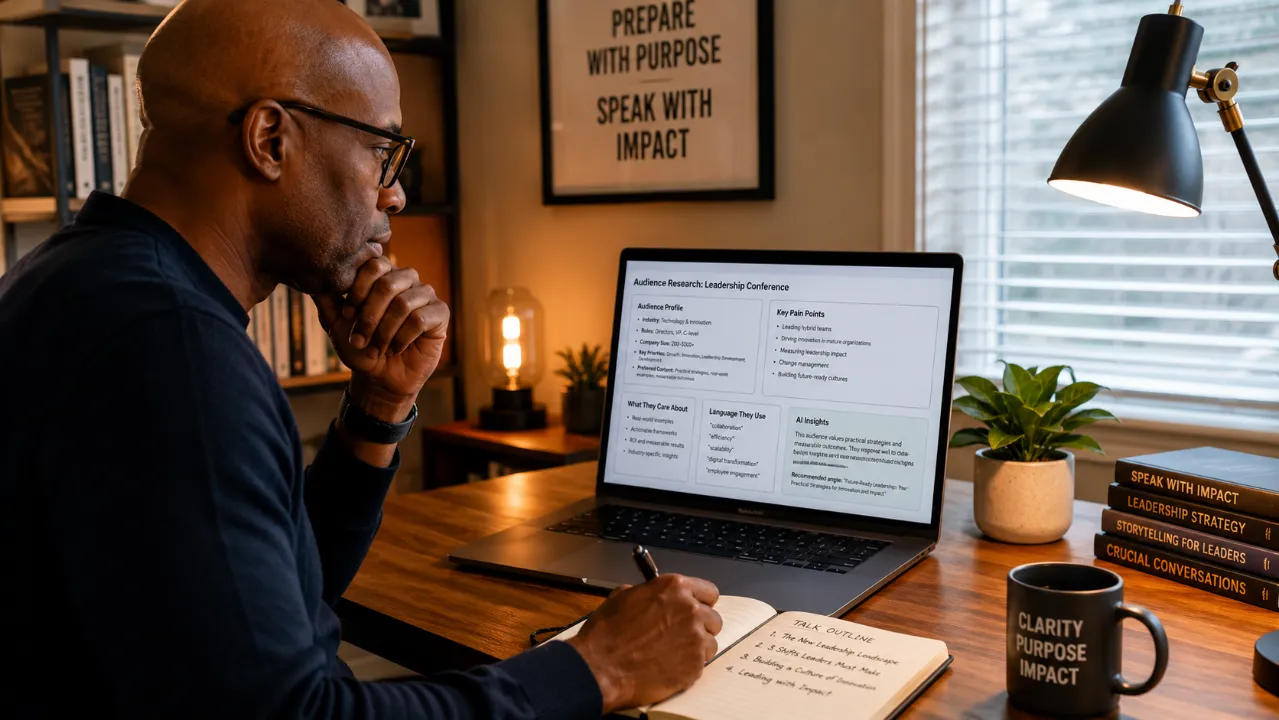
Will AI replace keynote speakers? You have seen the headlines. You have heard the conversations at speaker events. You have probably had the thought yourself, late at night when nobody is watching.
Will AI take my place? If that question has been sitting in the back of your mind, you are not alone. Almost every speaker I talk to is carrying it right now.
Table of Contents
And here is what makes it worse. The speakers who are ignoring that question are already losing bookings to speakers who show up more prepared, more customized, and more relevant to the specific audience in front of them.
The window for getting this right is not staying open forever.
I know because I almost missed it myself. In 2020, COVID wiped my calendar clean in two weeks. Gigs I had worked years to book disappeared overnight. I returned deposits. Most speakers I knew never came back. AI is the second filter. And this one has no end date.
Here is the good news. This is a problem with a real answer, and I have been living it. AI is not the threat to great speakers. It is the end of average ones.
In this post I am going to show you exactly which side of that line you are on and what to do about it starting right now.
What AI Is Actually Doing to the Speaking Industry
Why the Celebration Is Premature
Here is the thing. The speakers cheering the loudest for AI right now are often the ones most at risk. They see AI as proof that the industry is evolving and that they are evolving with it.
What they are missing is this. AI does not lift everyone equally. It rewards the exceptional and exposes the average.
If you are already delivering real value on stage, AI becomes your best friend. If you have been getting by on decent, AI just made decent free. And organizations know it. That changes everything.
The COVID Parallel Nobody Is Talking About
COVID was the first filter. It shut down live events completely. Calendars booked six months out went empty in two weeks.
The speakers who survived were the ones who adapted fast, built virtual delivery skills, and found new ways to serve their audiences. The ones who waited for things to go back to normal waited too long.
AI is the second filter, and it is running the same play with one critical difference. COVID had an end date. This does not. This is the permanent new condition of the industry.
COVID removed opportunity. AI removes the need for mediocrity. Those are very different things.
What Organizations Expect Now That They Did Not Before
Meeting planners and HR directors are using AI too. They are researching speakers more thoroughly than ever. They are comparing content quality, checking reputations, and expecting a level of customization that was rare five years ago.
When a speaker walks into a room without having done deep research on that specific audience, organizations notice now in a way they never did before. The bar for preparation has moved. The speakers who do not know that yet are already behind.
5 Hard Truths Every Speaker Needs to Face About AI
1. AI Cannot Do What a Great Speaker Does on Stage
Will AI replace keynote speakers? Not the great ones. Not ever. AI cannot read the energy shift in a room when an audience is starting to lose focus. It cannot call out someone in the third row and watch their entire team stand up and cheer for them.
It cannot pause in the middle of a story because it sees someone tearing up and knows the moment needs space. That is not a skill you train a machine to replicate. That is a human being who has lived something real, standing in front of other human beings who need to hear it.
I came to America at 21 years old with five dollars, two shirts, and one pair of pants. I washed cars in a Miami parking lot. I spent 14 years working as a doorman in Atlanta.
The message I carry about resilience and change is not something I downloaded. I earned it. When I stand on a stage for companies like Coca-Cola, AT&T, and Aflac and share what that journey taught me, no AI version of that talk exists. Because no AI went through it.
AI cannot replicate the pause before an emotional story. It cannot feel a room shift and move with it. That is the human gift, and right now audiences are starving for it.
2. AI Will Absolutely End the Canned Presentation Career
Here is the hard truth. If your value is delivering the same presentation you have given a hundred times with minimal customization, AI can do that now. Better and cheaper.
Organizations know it. Meeting planners know it. The speakers who do not know it yet will learn it the hard way.
The canned presentation career is over. The speaker who memorizes 45 minutes of content and repeats it from city to city with the same slides and the same jokes is not competing with other speakers anymore. They are competing with AI. And they will lose.
3. AI Gives Great Speakers Superpowers They Could Never Afford Before
Let me tell you where I stand on this. The day ChatGPT launched, I dove in headfirst. I spent countless hours learning, testing, and mastering every tool I could get my hands on.
I was not dabbling. I was building. Right now I am miles ahead of most speakers in how I use AI, and honestly, AI is practically running my business.
I am telling you that not to brag but to show you what is possible when you commit to it.
Before AI, deep audience research cost thousands of dollars through specialized research firms. Only the top earners had access to it.
Today, any speaker willing to learn the tools can know more about their audience before walking on stage than most speakers knew after being in the room for an hour.
I use AI to study the specific pain points of every audience I speak to. I build customized stories around their industry, their challenges, their language. I tailor the humor so it lands for their culture.
The result is a presentation that feels like it was built specifically for them, because it was. That level of customization used to be reserved for the highest-paid speakers in the world. AI made it available to any speaker willing to put in the preparation time.
AI gives speakers superpowers we could never afford before. The speakers who understand that will leave everyone else behind.
4. The Preparation Gap Is Now Visible and It Is Widening Fast
The speakers who use AI to prepare are visibly different from the ones who do not. Audiences feel it even when they cannot name it.
There is a difference between a speaker who studied your world before walking in and one who showed up with a generic presentation and hoped it would land. That difference has always existed. AI has made it impossible to hide.
When I spoke for a financial services organization last year, I used AI to research their top leadership challenges, their recent announcements, and the language their executives use internally.
I built specific references into my talk that made the room feel like I had been working with them for months.
I had been preparing for three days. That is what AI makes possible. And the gap between speakers who do this and speakers who do not is widening every single quarter.
5. The Human Side of the Stage Has Never Mattered More
The final truth is the one that matters most. Because AI can now handle so much of what was previously difficult, the thing it cannot handle becomes the most valuable thing in the room.
The empathy. The compassion. The ability to look at 500 people and make each one feel seen. The willingness to tell on yourself, share your failure, and sit in the discomfort of a hard truth alongside your audience instead of lecturing from a safe distance.
In a world where more and more content is generated by machines, a real human being with a real story and a genuine desire to serve their audience is not just valuable. They are rare. And rare commands a premium.
As author of Kick Your Excuses Goodbye and a speaker who has served over a thousand audiences, I can tell you that the single most powerful moment in any talk is never the most polished one. It is always the most human one.
What the Thriving Speakers Have in Common
Use AI Before You Walk on Stage, Then Put It Down
Here is what the winners figured out that the struggling ones have not. AI belongs in your preparation, not in your performance. Use it to understand your audience at a depth that was never possible before. Use it to sharpen your stories, your humor, your takeaways.
Then put it down and show up as a human being. What the audience experiences is a speaker who somehow knows exactly what they are going through and has exactly the right story for this moment. That is not magic. That is preparation done right.
Build the Thing AI Cannot Copy
Look, the speakers who are winning right now did not get there because of AI. They got there because they did the inner work first. They processed their own story and found the universal truth inside it.
They built the emotional presence that makes an audience trust them within the first three minutes. That work is on you. No tool does it for you.
It comes from showing up, doing the reps, and being willing to be genuinely human in front of strangers. The craft is real. And right now, the craft matters more than it ever has.
How to Get on the Right Side of This Shift
Two Moves That Separate the Thriving From the Disappearing
The first move is to start using AI for audience research before every single engagement. Before your next event, use AI to study that audience’s industry, their current challenges, what is keeping their leaders up at night, and what language they use to describe their problems.
Then build your customization around what you find. Do this for ten engagements in a row and watch what happens to your re-booking rate and your referrals.
The second move is harder, and it is the one most speakers skip. Be honest with yourself about what you actually deliver on stage. Not what you believe you deliver. What the audience actually experiences.
Call three recent clients and ask them one question: what was different about their team six months after you spoke? If you cannot answer that with something specific and concrete, you know exactly where your real work is.
Harvard Business Review has written about this for years. The leaders who create lasting impact pair real emotional connection with practical tools the audience can use Monday morning.
AI helps you prepare both. Only you can deliver them once you are in the room.
The Stage Still Belongs to the Real Ones
Let me conclude by saying this. Will AI replace keynote speakers? It will replace the ones who were never truly irreplaceable. The ones who were coasting on a decent presentation and hoping nobody would notice. For them, the window is closing faster than they think.
But for the speakers who show up fully human, who use every tool available to prepare deeply, and who have something real to say to the specific people in front of them? The stage has never been more valuable.
Audiences are drowning in synthetic content. A real human being who has lived the lesson and can make a room feel it is not just competing with AI. They are the antidote to it.
No condition is permanent. This shift is real and it is not reversing. The question is not whether AI will change the speaking industry. It already has. The question is whether you are going to be the kind of speaker AI makes better or the kind AI makes irrelevant.
There you have it. The stage is still here. It just belongs to fewer people now. Make sure you are one of them.
Much success to you! Press on!
Frequently Asked Questions
Will AI replace keynote speakers completely?
AI will not replace keynote speakers who deliver genuine human connection, real-time audience response, and deeply personal stories. It will replace speakers who rely on canned presentations with little customization.
The great ones become more valuable. The average ones become unnecessary.
How is AI changing what organizations expect from speakers?
Organizations are using AI themselves to research and compare speakers more thoroughly than ever before. They now expect a level of customization that was rare five years ago.
Speakers who show up without deep knowledge of their specific audience are being passed over for speakers who clearly did the work.
What can a human speaker do that AI can never replicate?
A human speaker can read a room in real time, pivot when the energy shifts, call out an audience member and make their peers cheer for them, and share a story with the weight of someone who actually lived it.
These are human gifts. No AI can manufacture them, and audiences know the difference immediately.
How should speakers use AI to improve their presentations?
Use AI for deep audience research before every engagement. Study their industry pain points, their language, their current challenges, and what their leaders care about most.
Use that intelligence to customize your stories, humor, and takeaways. AI is a preparation tool. The performance still belongs to you.
Is the speaking industry growing or shrinking because of AI?
The speaking industry is not shrinking. It is splitting. Speakers who combine strong human presence with smart AI-assisted preparation are thriving and commanding higher fees.
Speakers who have not adapted are losing bookings. The demand for live human speakers is strong, but the middle of the market is being squeezed harder than ever before.
What separates speakers who thrive with AI from the ones who struggle?
The speakers who thrive use AI before they walk on stage and leave it there. They prepare at a depth that was never possible before, then show up fully human in the room.
The ones who struggle are either ignoring AI entirely or leaning on it as a substitute for the real work of building genuine stage presence and a personal story worth telling.

0 Comments