Imagine you go to a Beyoncé concert. You’ve had a great night. Then the lights come up, and she never sang the one song you came to hear.
You’d turn to the person next to you and say, “Wait a minute. She didn’t sing it?”
That’s what a signature story is to a speaker. It’s your hit song. You can tell other stories in your keynote. This is the one people hope you’ll tell again. It’s the story they think of when they hear your name.
And if you’ve done it well, it gives people something they can say to each other after you leave.
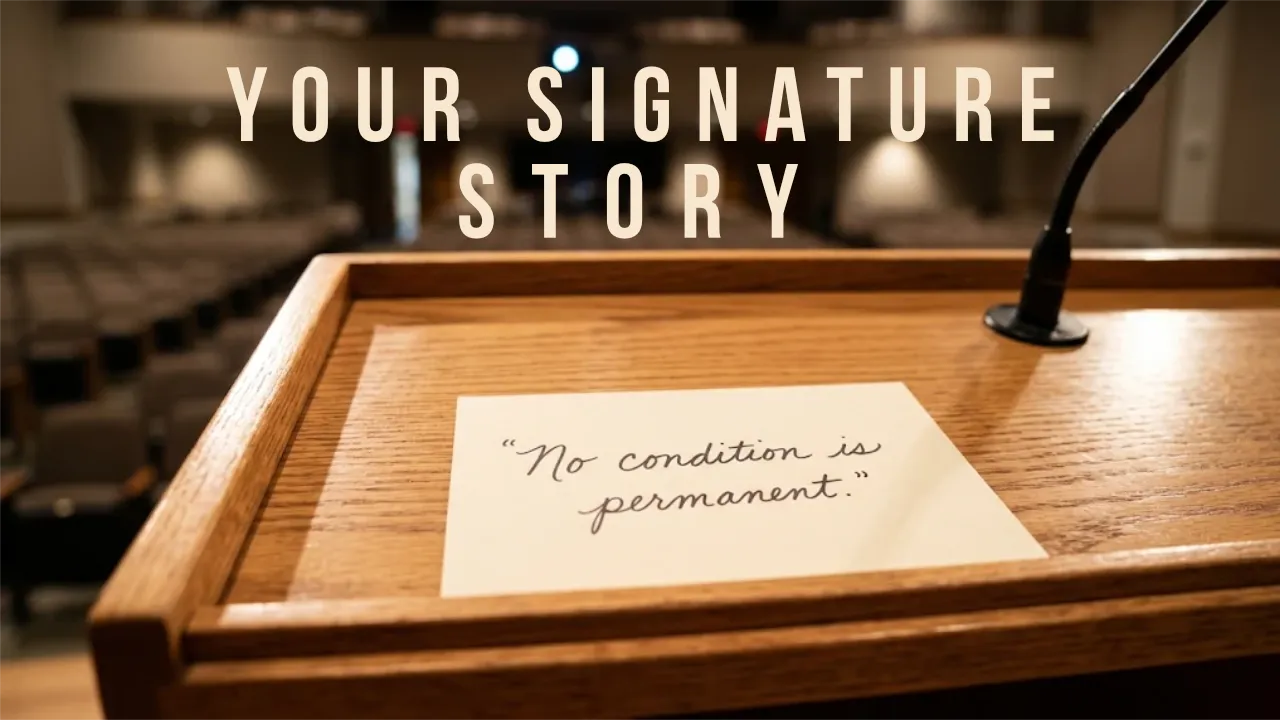
For me, those words are “No condition is permanent.” I’ll be talking to a family member, and they’ll say it right back to me. I love hearing that. They’ve found a place for those words in their own lives.
If you’re wondering how to find your signature story, grab a pen. By the time you finish these five questions, I want you to have three stories you can try out loud.
1. How to Find Your Signature Story by Starting With Your Message
Before you go looking through your entire life, ask yourself what you want people to believe and do. Finish this sentence.
When people leave my speech, I want them to believe ______ and do ______.
When I say “No condition is permanent,” I want someone who feels stuck to believe their situation can change. Then I want them to take one step they can take today. Maybe it’s making a call they’ve been putting off. Maybe it’s asking somebody for help.
Now I know what kind of story to look for. When did I feel like my situation would never change? What was the first thing I did that gave me a chance to change it?
Here’s the sentence I want you to write under your message.
I know this is true because I remember when ______.
Finish it five different ways. Give yourself time to think. A conversation from your first job might explain why you teach something today.
2. What stories do you already tell when you’re just talking?
I can be coaching a speaker, and somewhere in the conversation they’ll tell me something that happened to them. They might spend two minutes on it and move right along. I’ll stop them and say, “Wait. Do you tell that story onstage?”
“No, not really.”
And I’ll say, “That’s your signature story.”
They’ve lived with that memory so long it feels ordinary to them. I’m hearing it for the first time, and I want to know what happened next.
Go back to your list and add five more memories. Give each one a short title. “The day I got turned down at McDonald’s” is enough for now. You’ll write out the story later.
- When did somebody see something in you before you saw it yourself?
- When did you feel overlooked? What do you wish somebody had done?
- When did you get something wrong and have to change your mind?
- When did one small act change how much effort you wanted to give?
- What story do your friends or family already ask you to tell?
If your mind goes blank, ask somebody who knows you, “What’s a story I’ve told you that you still remember?” Let them tell it back to you. The part they remember might be the part you were about to cut.
3. Where does something change in the story?
My signature story comes from growing up poor in a tiny village in Haiti and coming to America. That covers years. For a short talk, I can take you straight to one parking lot.
I couldn’t get a job picking up trash at McDonald’s. I didn’t speak English. Now tell me. Since when do trash cans speak English?
I still had to eat. So I took three dollars and started washing cars in the parking lot of a bank. The first car I washed paid me five dollars.
Right there, you can see the shift. I’d been asking people for a job. Now I could walk up to somebody with a dirty car and offer to wash it. You can hear why I believe no condition is permanent.
Go back to your list. Under the memories that stand out, write down where you were, who was there, what you wanted, what surprised you, and what changed afterward. If you wrote, “I learned to appreciate people,” ask yourself, “What happened on the day I learned that?”
Use the details you remember. If you remember what someone meant but can’t recall their exact words, say what they told you in your own words.
4. Which three stories are worth trying out loud?
Look at your ten memories and choose three. I’d look for a moment you can take me to, something you wanted or had to decide, and a change I can see. Then ask what the person listening can take from it.
Here’s a simple outline. Fill it in for each of your three stories.
I was ______.
I wanted ______.
Then something happened I didn’t expect. ______.
I had to decide ______.
That experience changed the way I think about ______.
For the people in this room, that means ______.
Tell each story into your phone. Listen to where you finally get to the part that makes you want to hear what happens next. Try starting closer to that moment.
Then tell the stories to somebody else. Before you explain what you meant to teach, ask them three questions.
- What moment stayed with you?
- What did you think the story was about?
- Where did you want me to slow down, give you more detail, or move on?
Suppose they remember that I washed cars for five dollars, but all they heard was a story about how to make money. I’d know the scene stuck. I’d also know I need to make the connection to rejection clearer. That gives me something specific to work on before I tell it again.
5. What words do you want people to repeat?
In speaking, you’ll hear people call this a phrase that pays. It’s a line short enough for somebody to remember and say to another person.
Mine is “No condition is permanent.”
By the time I say it, you’ve heard where I came from and what I had to work with. You can hear why I believe it. Then I can bring those same words back when I ask you to think about a condition in your own life. Now those words belong to you, too.
Try saying your lesson in one sentence. Could somebody repeat it tomorrow in a conversation? If it sounds too formal, go back to the recording. Listen to how you told the story when you were just talking. You may have already said the line you need.
Put that line where the audience can hear why it matters. Let them see what happened first. Then say the words and give them a second to sit with it.
Take the story into a real room
Your early speaking engagements are a good place to work on this. Take one story to a civic club. After the talk, pay attention to what comes up when somebody walks over to speak to you. Do they bring up a moment from the story? Do they repeat the phrase? Do they tell you where it fits in their own life?
Keep telling it. A detail you forgot may come back to you next week. Write it down and see whether it helps the audience understand what happened. I’ll show you how to shape those details into a story that holds an audience in another post.
When you find the story that carries your message, give it the practice it deserves. Know how you’ll open it. Know where you’ll pause. Know exactly how you’ll land the line. For more ways to rehearse, see these speech preparation tips from Toastmasters.
If you need a room to try your story, I share where I found my early audiences and what I’d say to a civic club organizer in my guide on how to become a motivational speaker with no experience.
What do you want me to teach you next?
Maybe you have three stories and can’t decide which one to tell. Maybe you’ve found the right moment but can’t put the lesson into words people will remember.
Leave your question in the comments below. Tell me what you want to learn about finding, writing, or telling your signature story. I’ll use your questions to decide what to teach next.