If you want to know how to become a motivational speaker, start with this. No license is required. No certificate either. Nobody will check your credentials at the door. Nobody is going to hand you permission.
That is the good news. It is also the uncomfortable news, because it takes away the best excuse most people have for not starting.
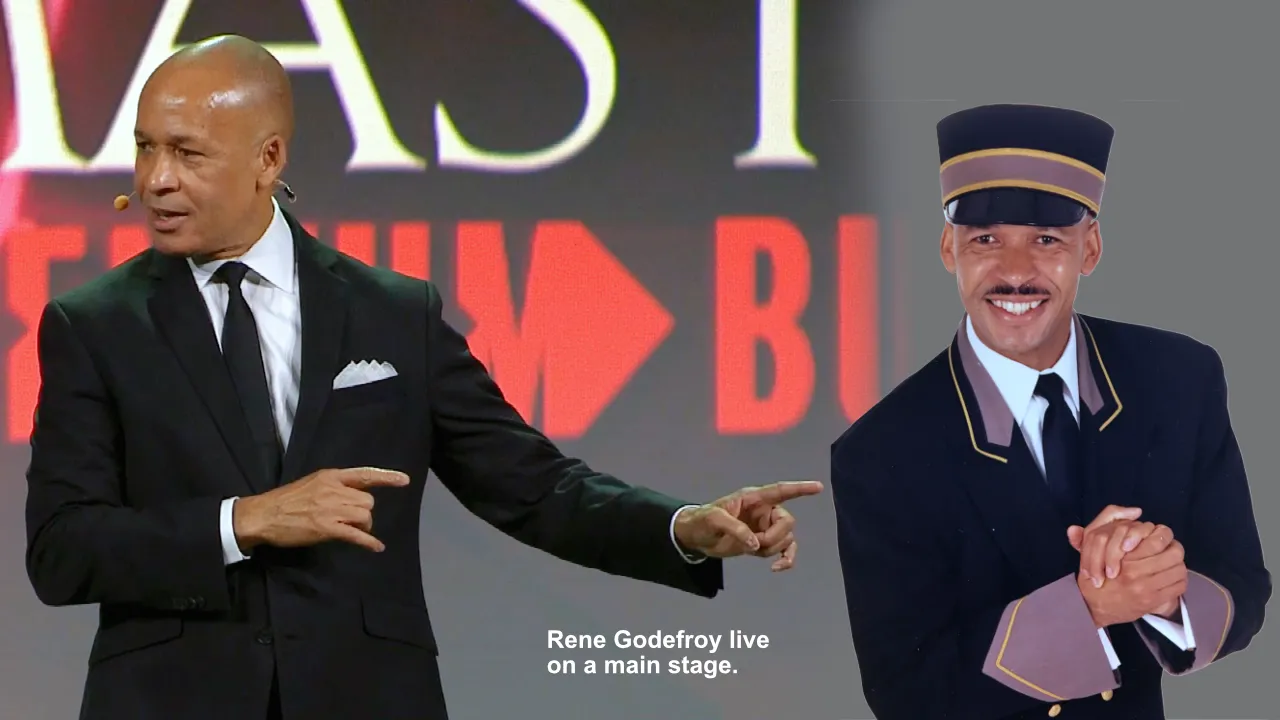
I know something about waiting for permission. For 14 years I worked as a doorman at an Atlanta hotel. I carried bags. I parked cars. And when my shift ended and the conference rooms were empty, I walked up onto the stage and practiced being the speaker.
Nobody had hired me. Nobody had asked me to. I was a doorman rehearsing for a job I did not have yet.
I learned which books to read from the tapes and books I saw in guests' back seats. I learned how to dress by watching the guests who walked through my door.
Here is what that empty stage means for you. You do not become a speaker when someone approves you. You become one when you start doing the work and collecting the proof that makes someone say yes.
This guide covers the path in order, plus honest answers on money, licenses, certification, and what to do when you have no experience.
The short answer: To become a motivational speaker, choose one audience, build a message from your own true story, turn it into a talk you can deliver well, speak for free on purpose to get practice and proof, then ask for paid engagements. No license is required to speak. Proof is what gets you booked.
What a Motivational Speaker Actually Does
A motivational speaker stands in front of a group and helps them see something differently, then do something about it. The stage might be a corporate conference, a school, a nonprofit gala, a church, a sales kickoff, or a virtual event.
The talk is not the whole job. You also find the audience, shape the message, write the talk, get booked, travel, deliver, follow up, and ask for the next engagement. Many speakers add coaching, workshops, books, and courses.
Most people picture only the stage. A lot of the work happens before and after it.
Do You Need a License, Certification, or Experience?
No license is required to be a motivational speaker. You can start today.
Certification is optional. It may give you structure and a community. Associations such as the National Speakers Association are another place to find that community. It will not book you on its own.
Put yourself in a planner's chair. A planner has to decide who stands in front of a room full of people. Can you deliver? Will my audience care? Has someone like me hired you before? A certificate does not answer those questions by itself. A video and a testimonial can.
Experience matters, but a long list of past stages is not the point. You need a message, a talk that works, and evidence that it works.
People ask me about credentials. I tell them I have a PhD: Persistence, Hope, Dream.
Step 1: Pick the One Group You Serve
"I speak to everyone." New speakers say it, and it sounds generous. In practice, it leaves a planner with nothing to picture.
Pick one group. Managers. Nurses. Sales teams. Students. Veterans. Nonprofit leaders. A planner should be able to read your name and picture the room you belong in.
I serve leaders who want to keep good people. That is a room. When I walk in, the people there already care about the problem I speak about.
To find yours, ask two questions. Whose problem do I understand from the inside? And who would recognize themselves in my story?
Start narrow. You can widen later.
Step 2: Find Your Message
Your message is what your biography proves.
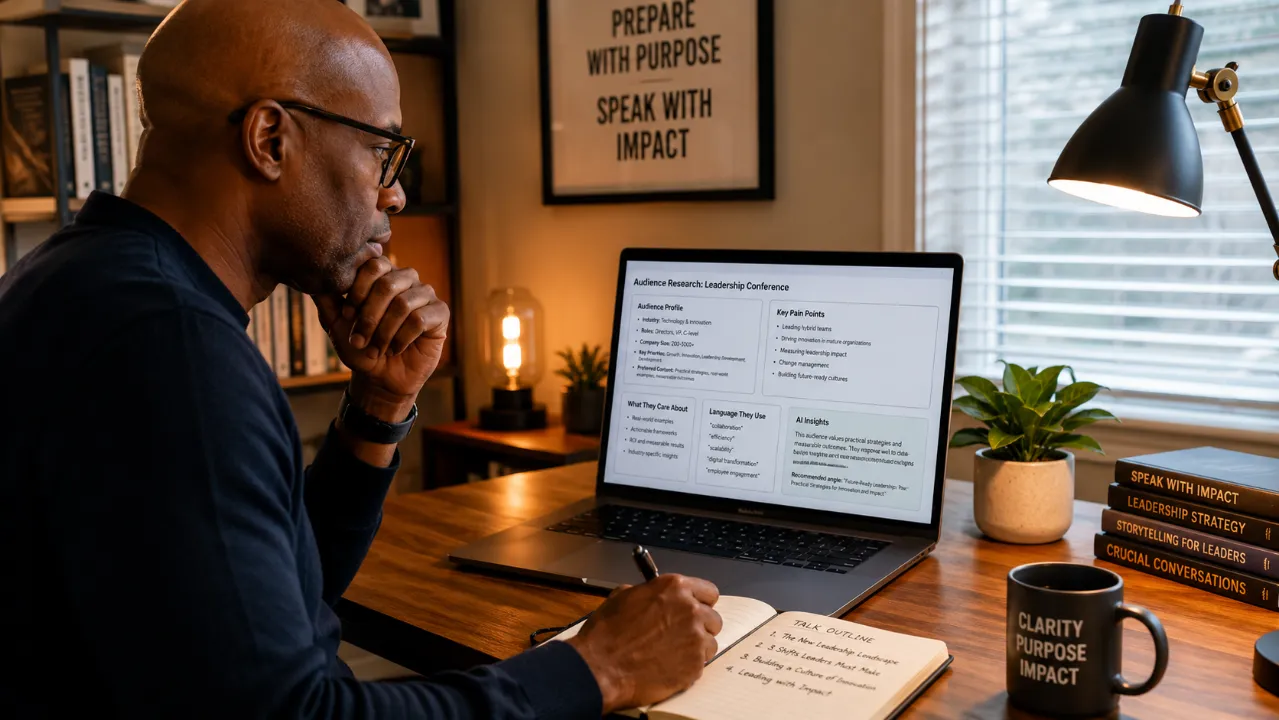
Here is the rule I teach: it is never about the story. It is about the story of the story. You tell what happened, then you turn and tell the audience what it means for them. A story left hanging is just a memory. A story turned toward the listener is a message.
Start by writing down three or four moments from your life that changed you. Then for each one, finish this sentence: "What this taught me that you can use is..."
Be careful with the stories you tell about yourself. Your condition is a fact. The story you build about your condition is not a fact.
Keep it honest. Never borrow someone else's story and tell it as yours. Never add details that did not happen. A planner may call your last client, and an audience can sense a story that was polished past the truth.
Step 3: Build a Talk You Can Deliver
A talk is a structure, not a speech you recite. Build it so you can deliver it well on a tired day, in a cold room, after a late flight.
Keep three things.
One main idea. If you cannot say it in one sentence, the audience cannot repeat it.
No more than three takeaways. People remember three. They forget the seventh.
A clear turn. Open with a moment that grabs attention. Move through your story. Then turn to the audience and tell them what to do with it.
Make the talk about them
I once spoke for the Family Resource Agency of North Georgia. I thought I did well. The meeting planner sent me the feedback forms. I had bombed.
One woman said the speaker was full of himself. She said the talk was all me, me, me. She said there was no audience in it.
I was hurt. I sat down and reflected on the event. She was right.
I hired a coach to work on my keynote. He fixed the problem. That was when my speaking career really took off.
Before you finish any talk, ask who it is for. If the honest answer is you, rebuild it. Your story is the way in. The audience is the reason you are there.
Then practice. I rehearsed on empty conference stages after my shifts. Get on a real stage when you can, or any room with a back wall. Record yourself and watch it. Notice where your energy drops and where you rush. Fix one thing at a time.
Record every talk from this point on. You will need the video in Step 5.
Step 4: Speak for Free, on Purpose
Free talks are your training ground and your proof. A free talk with nothing to show for it is just time you gave away.
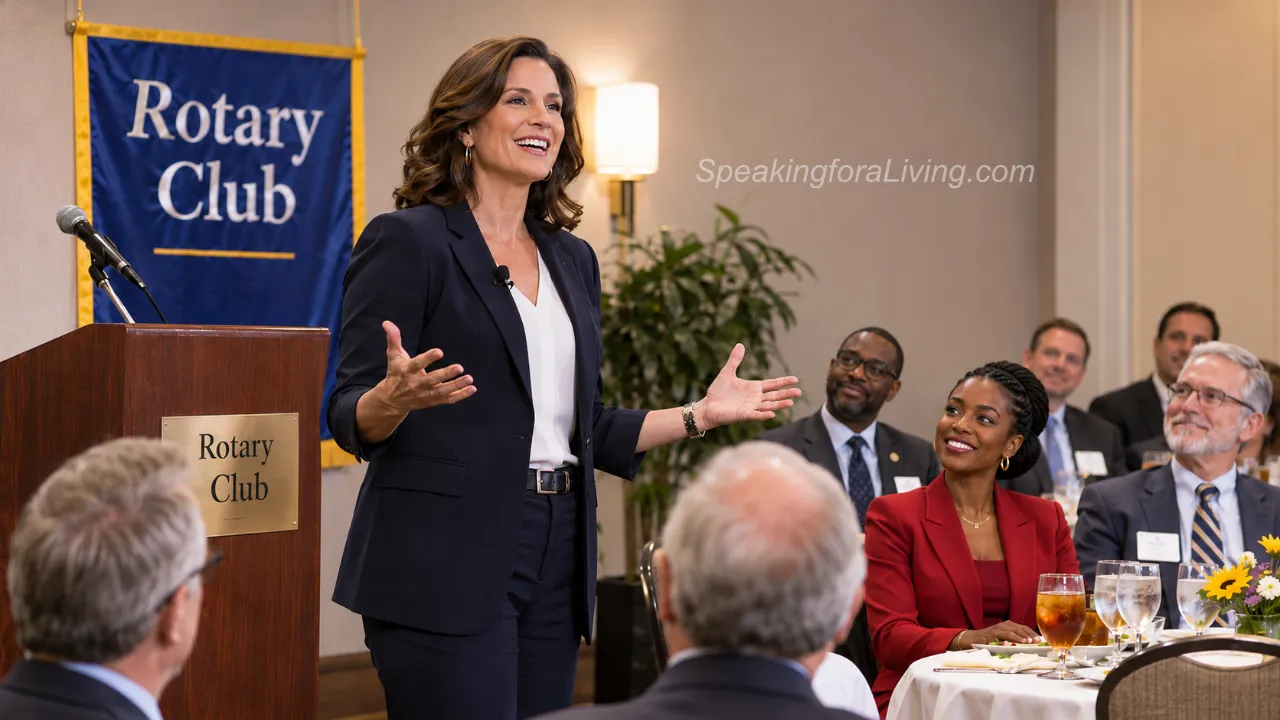
Look for audiences that already gather: Civic and local clubs and associations, schools, churches, libraries, community groups, company lunch-and-learns, chamber of commerce meetings, and virtual events that need speakers. Offer a specific talk with a clear takeaway, not "I'd love to speak to your group."
Before you say yes to any free talk, decide what you want from it. Ask for three things:
- A video recording of your talk.
- A short written testimonial from the organizer.
- An introduction to one other person who books speakers.
If you leave a free talk without any of those, you gave your time away. Do that ten times, and you have ten talks and nothing a planner can look at. If you leave with all three, you were paid in the currency that gets you hired.
Say no to free talks that cannot give you any of the three.
My first paid talk came from a free one
I was giving a free speech at the Shepherd Center in Atlanta. A woman approached me. She asked, "How much would you charge to speak to my team?"
I had no idea. I had not set a fee yet. I hesitated. I said, "How much do you have?"
She said, "$1,500."
I was shocked. I could not believe what I heard. I said, "Absolutely." I asked if she wanted me to come next week. She said no. The event was three months away. We booked it. That was my first paid gig.
I thought, if somebody will pay $1,500 for a few words, many others will too.
The lesson is simple. Someone in your free audience may ask what you charge, and the moment is short. Decide your number before the question comes.
Step 5: Build Your Proof
A planner will not book you on a promise. Planners tend to book proof.
Your first set of proof is simple:
- A short video of you speaking to a live audience. Phone footage is fine to start. A clearer video comes later.
- Two or three written testimonials from people who heard you.
- A one-sheet: one page that says who you serve, what you speak about, what the audience walks away with, and how to reach you.
- A simple website with your topics, your bio, your video, and a way to contact you.
Keep the language about the audience, not about you. "Your managers will leave with three questions they can ask their team this week" gives a planner more to work with than "I am a passionate and dynamic speaker."
Step 6: Ask for Paid Engagements
Paid work starts when you ask for it. You can wait to be discovered, or you can go back to the groups that already heard you and ask. Only one of those is a plan.
Ask the organizers whether they have a paid event coming up, or whether they know someone who does. Pitch planners in your chosen audience with a short note: who you are, the room you serve, one line on what the audience walks away with, a link to your video, and a testimonial.
Then follow up. One email is rarely the whole conversation.
You are always auditioning. I learned this in a Miami parking lot. I had $3 for supplies, two used towels, and dish soap from the dollar store. I asked drivers if I could wash their cars. Lots of them said no. One said yes. I did a spectacular job on his green Saab. I charged $5 a car.
Every free talk, every email, every conversation after an event is the same thing. Someone in that room is connected to your future. Treat every one of them like the green Saab.
When the answer is no, do not get bitter. Get better.
How Motivational Speakers Get Paid
Speakers earn money in several ways, and the stage fee is only one of them.
Speaking fees. The amount you charge for a keynote, breakout session, or workshop. What a speaker charges depends on the audience, the event, the speaker's proof, and how much demand there is. It is not a single number. My first paid talk was $1,500, and I will not hand you a table of figures I cannot source.
Honorariums. Some organizations offer a set amount instead of a negotiated fee. Schools often prefer to pay an honorarium. It is still paid work, and it still builds your proof.
Travel and expenses. Some events cover travel, hotel, and meals on top of the fee.
Books, coaching, workshops, and courses. Once people hear you, some will want more time with you. For many speakers, these add to long-term income.
How to Become a Motivational Speaker With No Experience
Then you start where I started. I came to America with $5, two shirts, and no English.
No experience means you have not collected proof yet. It does not mean you have nothing to say. You have lived through things. You have solved problems. You have learned something the hard way that someone in a room needs to hear. That is your material.
What you lack is practice and proof. Both come from Steps 3 through 5. A person with a clear message and three recorded free talks is often further along than someone with years of experience and no video.
Start this week. Pick your group. Write the one sentence of your message. Book one free talk, even for six people.
When People Tell You It Will Not Work
Some of them will.
A supervisor at the hotel once told me, "You'll never make it as a speaker with your English. Who will pay you to stand in front of corporate America?"
I told him I had a PhD. Persistence, Hope, Dream.
Years later I walked through the lobby of that same hotel holding my book. I was there to speak.
You will meet a voice that tells you what you cannot do. Do not argue with it. Do not let it set the terms. Keep going and let the work answer.
Frequently Asked Questions
How do you become a motivational speaker with no experience?
Start with one audience and one message from your own true story. Build a talk, speak for free to get practice, and collect video and testimonials. Experience is built one engagement at a time, and the first ones are usually free.
Do motivational speakers get paid?
Yes. Many speakers are paid through speaking fees, honorariums, and related work like coaching, workshops, books, and courses. Early in a career, many talks are unpaid, and they are how a speaker builds the proof that leads to paid work.
Do you need a license or certification to be a motivational speaker?
No license is required. Certification is optional and does not replace proof. What helps you get booked is a clear message, a talk that works, a video, and testimonials.
How long does it take to become a paid speaker?
It depends on how often you speak, how clear your message is, and how many of the right people see you. I will not give you a number, because it depends on too many things.
What should a beginner speak about?
Something you can back with a true story and a clear takeaway, aimed at a group you understand from the inside.
Are You Ready to Speak for Pay?
Before you book your first free talk, find out where you stand. Take the Speaker Readiness Test. If you cannot yet check off the list in Step 5, you have your assignment.
Let Me Conclude by Saying
The stage in that hotel was empty when I walked onto it. I practiced anyway.
Your early years as a speaker may look like that. Free talks. Small rooms. Rehearsing on a stage nobody invited you to. It can feel like nothing is happening. The proof you are building is happening.
Book one free talk this week, even for six people. Write down the three things you will ask for. Then give the talk.
No condition is permanent. Start with the stage you can get.
There you have it. Much success to you! Press on!